

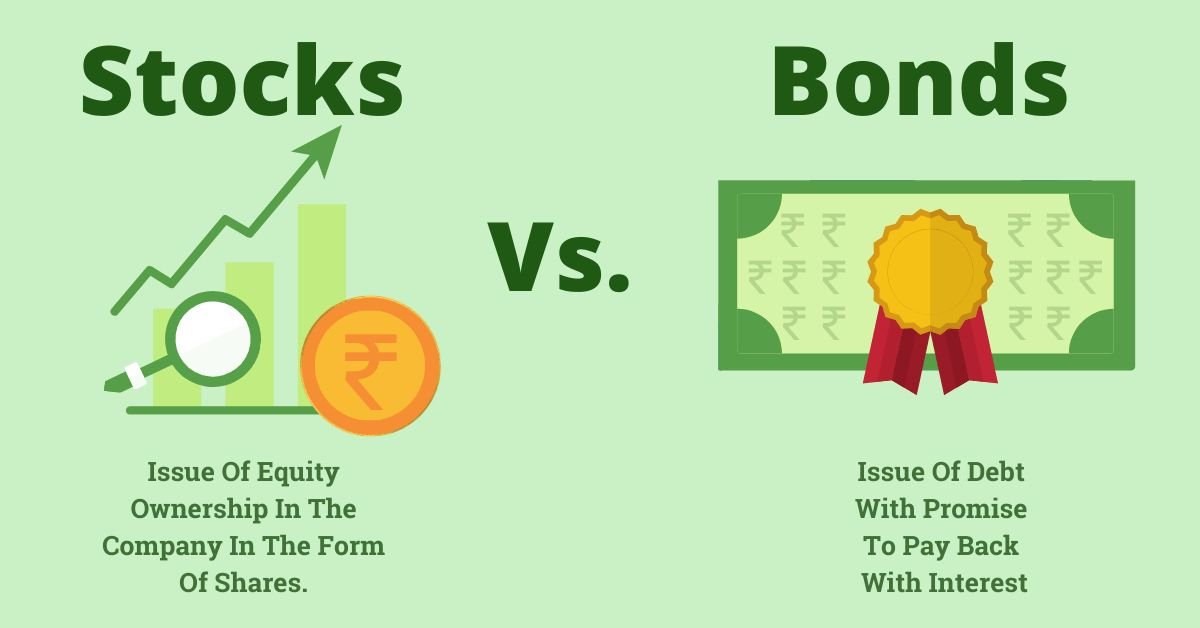
Stocks and bonds are two major types of investments, but they represent very different financial instruments.
Stocks generally represent ownership in a company, while bonds generally represent a loan made to an issuer. Because of this difference, stocks and bonds can behave differently and may play different roles in an investment portfolio.
Understanding these differences is important for anyone who wants to learn about investing.
What Are Stocks?
A stock represents an ownership interest in a company.
When investors purchase shares of a publicly traded company, they become shareholders. The value of those shares can change based on company performance, market conditions, economic developments, investor expectations, and many other factors.
Some companies also pay dividends to shareholders, although dividends are not guaranteed.
What Are Bonds?
A bond is generally a debt investment.
When an investor purchases a bond, the investor is lending money to an issuer. The issuer may be a government, municipality, corporation, or another organization.
The bond terms typically specify the interest payments and maturity date.
At maturity, the issuer generally repays the principal, subject to its ability to meet its obligations.
Ownership vs. Lending
The fundamental difference is ownership versus lending.
A stockholder owns part of a company.
A bondholder is generally a creditor of the issuer.
This difference affects how investors receive returns and what happens if the company or issuer experiences financial difficulties.
How Stock Investors Make Money
Stock investors can potentially earn returns in two primary ways.
The first is an increase in the stock’s market price.
The second is dividends paid by companies that distribute part of their profits to shareholders.
Neither outcome is guaranteed.
A stock’s price can fall, sometimes significantly.
How Bond Investors Make Money
Bond investors generally receive interest payments according to the bond’s terms.
They may also receive the principal amount when the bond matures if the issuer meets its obligations.
Some bonds can be sold before maturity, and their market value can rise or fall based on interest rates, credit conditions, and other factors.
Risk Differences
Stocks generally have greater price volatility than many high-quality bonds, although risk varies widely within both categories.
Individual stocks can experience large price movements.
Bonds also have risks. For example, if interest rates rise, the market value of existing fixed-rate bonds may decline.
Corporate bonds can also carry credit risk if the issuing company experiences financial problems.
Return Potential
Stocks generally have greater long-term growth potential than many bonds, but they also carry greater volatility.
Bonds can provide income and may offer greater stability in some portfolios, but their returns can be lower than those of stocks over certain long periods.
Past performance does not guarantee future results.
Interest Rate Risk
Interest rate changes can affect bond prices.
When market interest rates rise, existing bonds with lower fixed interest rates can become less attractive compared with newly issued bonds offering higher rates.
As a result, the market price of existing bonds may fall.
The effect depends on factors such as bond maturity, duration, coupon rate, and market conditions.
Credit Risk
Credit risk refers to the possibility that a bond issuer may fail to make required payments.
Government bonds, municipal bonds, and corporate bonds can have different levels of credit risk.
Investors should research the issuer and understand the credit characteristics before buying a bond.
Dividends and Interest
Stock dividends are distributions to shareholders and are not guaranteed.
Bond interest payments are generally specified in the bond agreement, but the issuer must have the ability to make those payments.
The tax treatment of dividends and interest depends on the country and the investor’s circumstances.
Liquidity
Liquidity refers to how easily an investment can be bought or sold without significantly affecting its price.
Large publicly traded stocks can often be highly liquid.
Bond liquidity varies significantly depending on the type of bond, issuer, maturity, and market conditions.
Stocks and Bonds in a Portfolio
Investors sometimes combine stocks and bonds in a portfolio.
The purpose can be to balance growth potential and stability.
For example, a portfolio with a combination of stocks and bonds may behave differently from a portfolio consisting entirely of stocks.
The appropriate allocation depends on the investor’s financial goals, time horizon, and risk tolerance.
Individual Securities vs. Funds
Investors do not necessarily need to buy individual stocks or bonds.
Mutual funds and ETFs can provide exposure to many securities through a single investment.
For beginners, diversified funds can sometimes provide broader exposure than selecting individual securities.
However, funds still carry investment risks and fees.
When Stocks May Be Considered
Stocks may be considered by investors who have a longer time horizon and can tolerate market fluctuations.
They can provide exposure to business growth and potentially higher long-term returns.
However, investors should understand that individual stocks can lose substantial value.
When Bonds May Be Considered
Bonds may be useful for investors seeking income, diversification, or a different risk profile from stocks.
Short-term and high-quality bonds can behave differently from long-term or lower-quality bonds.
Investors should examine the specific bond rather than assuming all bonds have the same level of risk.
Why Diversification Matters
Owning only one stock exposes an investor to the performance of one company.
Similarly, owning only one corporate bond exposes the investor to one issuer.
Diversification across multiple securities, industries, sectors, and asset classes can reduce concentration risk.
Diversification cannot eliminate market losses, but it can reduce the impact of problems affecting a single investment.
Stocks vs. Bonds During Market Changes
Stocks and bonds do not always move in opposite directions.
Their relationship can change depending on inflation, interest rates, economic conditions, investor expectations, and other factors.
This means investors should not assume that bonds will always rise when stocks fall.
Final Thoughts
Stocks and bonds serve different purposes.
Stocks represent ownership and provide exposure to company growth, while bonds generally represent loans to issuers and can provide interest income.
Stocks generally involve greater price volatility and higher growth potential, while bonds have their own risks, including interest-rate and credit risk.
Rather than viewing one asset class as universally better, investors should consider how each fits into their financial goals, time horizon, and risk tolerance.
Frequently Asked Questions
Are stocks riskier than bonds?
Risk varies by investment. Stocks often experience greater price volatility, but some bonds can also carry substantial risks.
Do bonds always provide fixed returns?
Not necessarily. Bond structures vary, and market prices can change before maturity.
Can I invest in both stocks and bonds?
Yes. Many diversified portfolios contain both asset classes.
Do stocks pay interest?
Stocks generally do not pay interest. Some companies pay dividends to shareholders.
Can bonds lose money?
Yes. Bond prices can decline, particularly when interest rates rise, and investors can face credit or default risk depending on the issuer.







Leave a Reply