

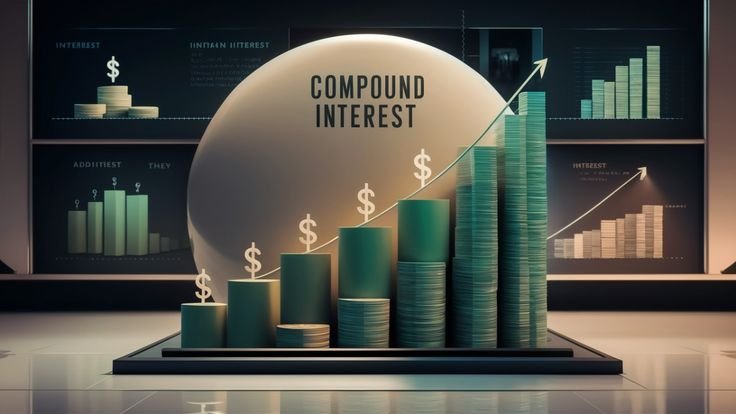
Compound interest is one of the most important concepts in long-term personal finance. It describes the process of earning returns on an initial amount of money and then earning additional returns on previous returns.
Over a long period, this can create significant growth. The same concept applies to some savings accounts, investments, and other financial products, although actual investment returns are not guaranteed.
Understanding compound growth can help people see why starting early and maintaining consistent contributions can matter.
What Is Compound Interest?
Compound interest occurs when interest earned on money is added to the original balance, allowing future interest to be calculated on a larger amount.
For example, suppose you deposit money into an account that earns interest. If the interest remains in the account, the next interest calculation can include both the original deposit and previously earned interest.
This creates a compounding effect.
Simple Interest vs. Compound Interest
With simple interest, returns are calculated only on the original principal.
With compound interest, returns can accumulate on both the original principal and previously earned returns.
The difference becomes more noticeable as time passes.
The Basic Compound Growth Formula
A common compound growth formula is:
Here, the future value depends on the starting amount, rate of return, and amount of time.
This formula assumes a fixed rate for illustration. Real investments generally do not provide a fixed return every year.
Why Time Matters
Time is one of the most important factors in compound growth.
When money remains invested for a longer period, there are more opportunities for returns to build upon previous returns.
This is one reason starting to save or invest early can be useful.
A person who starts earlier may have more time for growth to accumulate, even if the initial contributions are relatively small.
Regular Contributions
Compound growth becomes even more useful when investors add money regularly.
For example, someone may contribute a fixed amount each month to an investment account.
Each new contribution increases the amount that can potentially generate future returns.
Regular contributions can also create a consistent financial habit.
An Example of Long-Term Growth
Imagine someone invests $1,000 and earns an average hypothetical return of 6% per year.
If the returns remain invested, the balance can grow over time through compounding.
However, this is only an illustration. Real investments do not guarantee a 6% annual return, and actual returns may be higher or lower in individual years.
The example demonstrates the mathematical effect of allowing returns to remain invested.
Reinvesting Dividends
Some investments pay dividends.
If an investor chooses to reinvest dividends rather than taking them as cash, those additional shares or investments can potentially generate future returns.
Over long periods, dividend reinvestment can contribute to portfolio growth.
However, dividends are not guaranteed and can be reduced or eliminated by companies.
Compound Growth and Retirement
Compound growth is often discussed in retirement planning because retirement savings may remain invested for decades.
Starting early can provide more time for contributions and investment returns to accumulate.
For this reason, many retirement strategies emphasize consistent contributions over long periods rather than trying to find a perfect investment at a perfect moment.
The Impact of Fees
Fees can reduce the amount of money available to compound.
Suppose two investments have similar gross returns, but one has significantly higher ongoing costs.
The higher-cost investment may leave less money invested over time.
This is why investors should understand expense ratios, account fees, transaction costs, and other charges.
Inflation and Purchasing Power
Growing account balances do not automatically mean that purchasing power is increasing at the same rate.
Inflation can cause prices to rise over time.
For example, an amount of money that buys a certain basket of goods today may buy fewer goods many years later.
When planning for long-term goals, investors should consider both investment growth and inflation.
Compound Growth Is Not Guaranteed
Compound interest is a mathematical process, but investment returns are not guaranteed.
A bank savings product may have a stated interest rate subject to its terms.
Market investments such as stocks and funds can rise and fall.
An investment may lose value during some periods, and losses can affect the amount available for future compounding.
The Importance of Consistency
Consistency can be more practical than trying to make perfect investment decisions.
Regular contributions, keeping costs under control, maintaining diversification, and staying focused on long-term goals can support a disciplined approach.
Market conditions will change, but consistent financial habits can help investors remain focused.
Compounding and Debt
Compounding can also work against consumers.
Credit card balances and certain loans can accumulate interest over time.
If interest is added to an outstanding balance and remains unpaid, the debt can become more expensive.
This is one reason high-interest debt can be an important consideration before investing large amounts of money.
Start With What You Can Afford
There is no universal amount that every person should invest.
A sensible starting amount depends on income, expenses, emergency savings, debt obligations, and financial goals.
The key is to avoid investing money that may be needed immediately for essential expenses.
Avoid Chasing High Returns
The potential power of compounding can make high-return promises look attractive.
However, higher expected returns generally involve greater risk.
Investors should be cautious about opportunities promising guaranteed high returns with little or no risk.
Before investing, understand how the investment generates returns and what could cause the investment to lose value.
Final Thoughts
Compound interest can help explain why time, reinvestment, and consistency are important in long-term financial planning.
The process allows previous returns to remain invested and potentially generate additional returns.
However, actual investment performance is uncertain. Fees, taxes, inflation, market losses, and changing returns can all affect the final outcome.
The basic lesson is simple: starting early, contributing consistently, and allowing money to remain invested can give compounding more time to work.
Frequently Asked Questions
What is compound interest?
Compound interest is interest calculated on an initial amount plus previously accumulated interest.
Does compound interest guarantee wealth?
No. Compounding describes how growth accumulates, but investment returns are not guaranteed.
Why is starting early important?
Starting early gives money more time to potentially earn returns and benefit from additional periods of compounding.
Can investments compound?
Yes. Investments can experience compounding when returns remain invested and generate additional returns, although actual returns vary.
Do fees affect compound growth?
Yes. Fees reduce the amount of money that remains invested and can therefore reduce long-term growth.






Leave a Reply